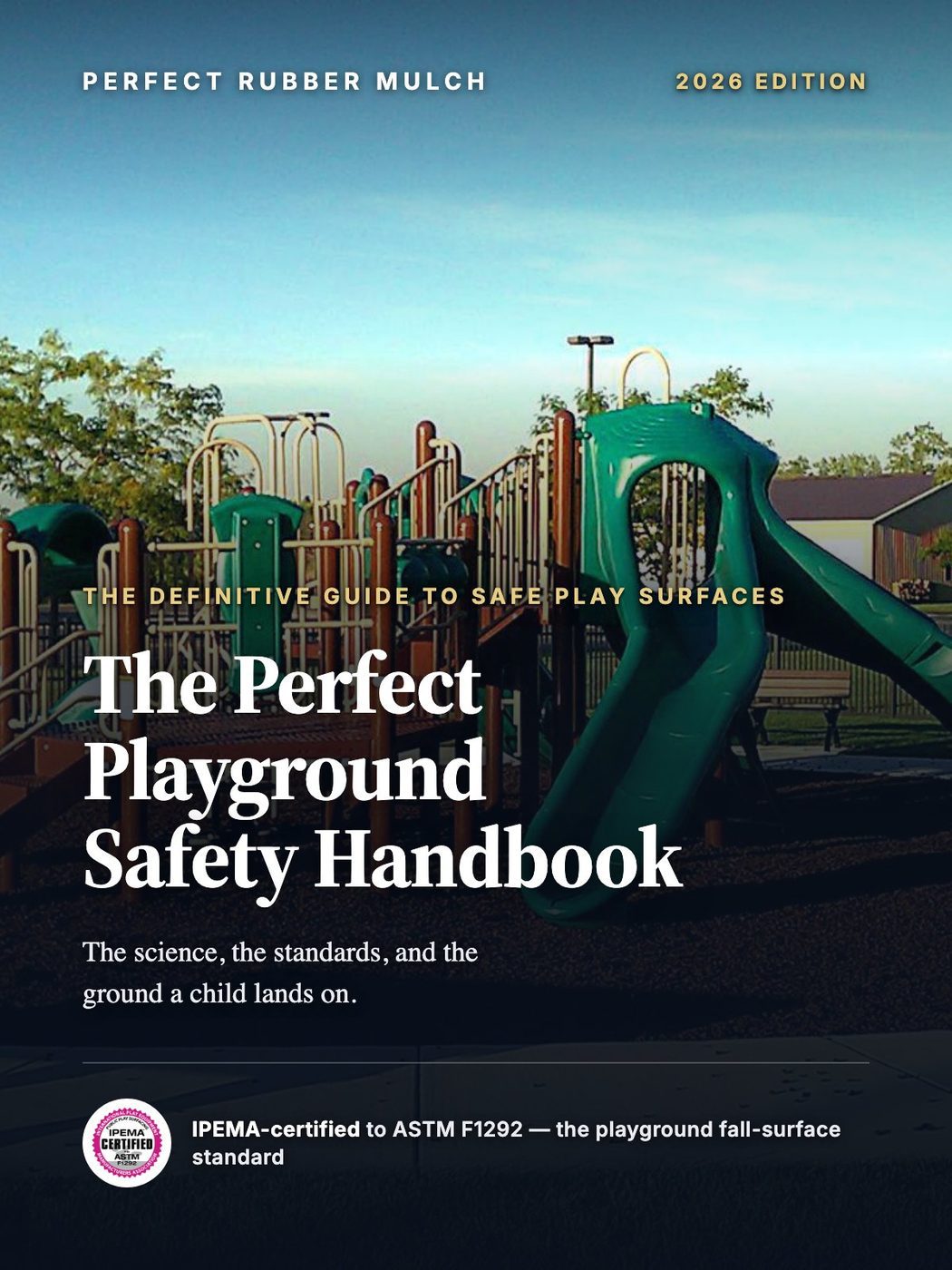
The Perfect Playground Safety Handbook
The ground a child lands on, explained in full. Since 2004 we've sold playground surfacing nationwide; this guide puts the science, the standards, and the buyer's tools in one place. It's for everyone responsible for that landing — parent, school board, parks director, daycare owner, facilities manager — so read it, then pass it on.
What's inside
A playground is really a promise.
Step onto a playground surfaced with certified rubber mulch and you'll feel it underfoot: a soft, springy give that stands ready before anyone needs it. At a demonstration we prove it the fun way — drop a watermelon from the top of a playset onto six inches of rubber mulch, and it lands without a crack.
That's the whole idea — protection under a child's feet, the playground's seatbelt. Quiet, always on, never the star of the show.
Every year, roughly 200,000 children are treated in U.S. emergency rooms for playground injuries — and according to the Consumer Product Safety Commission, the single largest cause is not broken equipment. It's the landing. The equipment gets the attention and the budget meetings; the surface beneath it does the work that matters most. So we wrote this handbook for everyone responsible for that landing — and you can hand it to anyone on your team.
Play hard, land soft, get back up laughing. — Your team at Perfect Rubber Mulch
The science of a safe landing.
A playground surface has one job — absorb the energy of a fall so a child's body doesn't have to. Certified rubber mulch does exactly that — to a 16-foot fall at 6 inches (IPEMA · ASTM F1292-22) — and holds the rating for a decade with no annual replacement. The pages below lay out the evidence: the two lab numbers, 60+ toxicity studies, every surface compared, the 10-year cost, and the board-ready templates.
The two numbers that decide everything
When a lab tests a playground surface, it drops an instrumented metal headform from increasing heights and measures two things:
G-max measures how suddenly the falling head stops — its peak deceleration. A surface fails above 200g.
HIC (Head Injury Criterion) weighs both the magnitude and the duration of that deceleration, and fails above 1,000. Both numbers come from the same measurement family behind automotive crash testing.
From these two numbers, each surface earns a Critical Fall Height (CFH): the tallest fall it can absorb, at its certified depth, while both numbers stay below threshold.
The recycled-rubber nugget mulch we ship certifies to ASTM F1292-22 at three depths — 10 feet at 4 inches, 12 feet at 5 inches, and 16 feet at 6 inches (verified in IPEMA's certified-product database). The CPSC's generic figure for recycled rubber sits lower, at 10 feet at 6 inches (Pub. 325, Table 2); a product's own F1292 certification can rate higher.
The standards that protect children, in plain language
ASTM F1292 — Impact Attenuation
The primary U.S. standard for impact performance. It defines the drop test and the G-max/HIC thresholds, and it stands behind any stated Critical Fall Height.
In practice: this standard proves the surface can protect a child's head from a fall at your equipment's height.
ASTM F3012 — Material Purity for Loose-Fill Rubber
Governs what's allowed to be in the bag: limits on hazardous metals including lead, restricts tramp (loose) steel, prohibits sharp contaminants, and sets particle-size requirements. The CPSC handbook states rubber mulch should be used on playgrounds only if it meets F3012. In practice: it verifies the material itself is clean and safe for kids who sit in it, dig in it, and occasionally taste it.
IPEMA — Independent, ongoing verification
A third-party program that goes beyond one-time testing: periodic site inspections, quality audits, and re-verification that today's product still matches what passed the lab. In practice: ASTM tests a sample once; IPEMA keeps checking. Require both.
ASTM F1951 & the ADA — Accessibility
Public playgrounds fall under the ADA, and F1951 measures whether a surface permits wheelchair travel. Loose-fill surfaces reach accessibility through added engineering — compacted sub-surfacing with wear mats at transfer points, unitary accessible routes to equipment, and maintained depth. Public buyers should plan accessible routes into the design from day one.
The toxicity question — what 20 years of independent science found
No question in surfacing has been studied more intensively than whether recycled tire rubber poses a health risk to children. The record runs unusually deep, spans two decades, and comes from agencies and universities with nothing to sell:
- The U.S. Federal Research Action Plan on Recycled Tire Crumb (EPA, CDC/ATSDR, CPSC, 2016–2019) — the largest study ever conducted — found measured exposures during normal play were low, generally at or near background levels.
- UC Berkeley review of crumb-rubber impacts (2010): ingestion of recycled tire rubber did not elevate cancer risk.
- Connecticut Dept. of Public Health (2010): exposures came in well within safe limits.
- Washington State Dept. of Health: no elevated cancer rates among the athletes studied.
- The EPA lists recycled-rubber landscaping among the designated products in its Comprehensive Procurement Guide — the federal program that recommends recovered materials for purchase.
- Independent toxicity testing immersed rubber mulch in acid stronger than stomach acid and saw virtually no reaction.
The real questions, answered one at a time
What about heat?
Every outdoor surface gets hot in direct sun. In comparative testing at 101°F ambient, rubber mulch measured up to 20°F cooler than play sand, though darker colors absorb more. On hot days, run a quick touch test before barefoot play and add shade where you can — the same rule for rubber, wood, or a metal slide.
What about fire?
Rubber does burn — it's rubber — but it resists ignition far better than wood. Under Federal Hazardous Substances Act testing, its recorded flashpoint was 610°F; wood mulch ignites at roughly 300–400°F.
What about pets?
Rubber is inert and non-hazardous; it doesn't attract chewing, insects, or animals, and toxicity testing showed virtually no acid reactivity.
Plants & soil?
Rubber doesn't decompose, so unlike wood it doesn't pull nitrogen from soil as it breaks down; water and air pass freely to roots. The EPA's Comprehensive Procurement Guide includes recycled-rubber landscape uses.
If a child swallows a piece?
No non-food material should be eaten — but the acid-immersion testing and the Berkeley ingestion findings place rubber mulch among the most-studied, lowest-risk loose fills on this question.
Odor & off-gassing?
Independent air testing found compounds at or below naturally occurring ambient levels for outdoor installations.
How it's made — and why the process is the safety story
Certified playground rubber mulch starts as end-of-life tires and moves through set stages. Shredding separates the tire fiber; magnets pull out the steel belts and wire; sizing screens the rubber into consistent nuggets.
Purity testing under ASTM F3012 then verifies the metal and contaminant limits. For colored products, a UV-stable pigment bonds to the nugget surface.
What every buyer should know: some nylon/rayon tire-cord fiber stays visibly embedded in finished nuggets, because fiber runs through tire sidewalls. It's a natural characteristic of the material — not a defect; the fiber is inert (it survived the same acid testing) and ASTM F3012 governs how much is allowed. A vendor who tells you their rubber mulch has zero fiber is describing a product that doesn't exist.
For buyers with sustainability mandates, one fact lands hard: the U.S. generates more than 250 million scrap tires a year (U.S. Tire Manufacturers Association). Certified surfacing counts among the EPA-recognized beneficial uses for them — a single line item that satisfies both the safety office and the sustainability office.
Every surfacing option, compared.
Critical Fall Height by material
| Surface material | Required depth | Critical Fall Height | Degrades? | Annual replacement? |
|---|---|---|---|---|
| Rubber mulch (F1292 tested) | 6 in | 16 ft | No | No |
| Pour-in-place rubber | 5 in | 12 ft when new | Hardens with age | Re-seal every 2–3 yrs |
| Wood chips (non-CCA) | 12 in / 9 in compressed | 10 ft | Decomposes | Yes |
| Engineered wood fiber | 12 in / 9 in compressed | 7 ft | Decomposes | Yes |
| Pea gravel | 12 in / 9 in compressed | 5 ft | Compacts / displaces | Yes |
| Fine sand | 12 in / 9 in compressed | 4 ft | Compacts; harbors bacteria | Yes |
Sources: CPSC Public Playground Safety Handbook (Pub. 325); independent impact-attenuation summaries. Rubber mulch achieves its rating at 6 inches because it doesn't compact the way organic and mineral loose fills do.
The ten-year cost reality
Wood fiber wins the first purchase order. Rubber mulch wins the next decade.
Engineered wood fiber runs about $1.65–$2.00 per square foot installed, versus $4–$8 for rubber. Wood then keeps costing: a 10–15% depth top-up every year, full replacement every 5–7 years, and delivery plus labor each round. One independent industry cost analysis put the gap at $31,000 or more in avoidable expense for a typical 1,000-sq-ft institutional playground over the long run.
Every surface, factor by factor
| Factor | Rubber mulch | Wood / EWF | Sand | Pea gravel | Pour-in-place |
|---|---|---|---|---|---|
| Fall protection (at depth) | 16 ft at 6″ | 7 ft at 9″ | 4 ft at 9″ | 5 ft at 9″ | 12 ft new |
| Performance over 10 yrs | Consistent | Degrades | Compacts | Displaces | Hardens |
| Annual replacement | No | Yes | Yes | Yes | Re-seal cycle |
| Freeze behavior | Stays loose | Freezes solid | Freezes | Freezes | Hardens further |
| Free drainage | Yes | Partial | Partial | Yes | No |
| Insect / pest attraction | No | Termites, ants | Ants, fleas, waste | No | No |
| Mold / mildew risk | No | High when wet | Moderate | No | Moderate |
| DIY-installable | Yes | Yes | Yes | Yes | No |
| ADA accessibility | ASTM F1951 certified at depth | Yes (maintained) | No | No | Yes |
Match the depth to the job.
For public and commercial playgrounds, match the depth to your equipment’s fall height: the IPEMA-certified rubber nugget mulch we ship is rated to 10 ft at 4″, 12 ft at 5″, and 16 ft at 6″ (ASTM F1292). Home playsets aren’t government-regulated — 3″ suits most, 4″ for a taller set; landscaping beds need about 2″.
Specification, installation & maintenance.
Depth requirements
| Installation type | Minimum depth | Basis |
|---|---|---|
| Landscaping / garden beds | 2 in | General landscaping practice |
| Home playground, low equipment | 3 in | Residential best practice |
| Home playground, taller equipment | 4 in | Residential best practice |
| Schools, daycares, parks, commercial | 6 in | CPSC guidelines — required for certified protection |
Add 10–15% to your calculated volume for displacement in high-traffic zones. Certified fall protection exists only at certified depth — a 6-inch surface worn to 3 inches under the swings is no longer the surface that passed the test.
So concentrate depth where falls happen. The fall zone — roughly 6 to 8 feet around the equipment — needs full depth; beyond it, depth is an aesthetic choice, not a safety requirement.
Use zones
The use zone is every spot a child could land, surfaced to the same standard as the ground under the equipment. That means a minimum of 6 feet in all directions from stationary equipment, and for swings, twice the pivot height both in front and behind. Your material requirement follows use-zone square footage — not the equipment footprint.
Installation that protects the investment
Who does what: Perfect Rubber Mulch ships nationwide — freight carriers deliver curbside to the 48 contiguous states. A homeowner, facilities crew, or local contractor handles the install itself, and these are the exact steps:
- Strip the use zone down to bare grade — clear existing surfacing, debris, and old vegetation first.
- Verify drainage; standing water under any loose fill degrades protection.
- Lay geotextile filter fabric — contains the rubber, passes water, blocks weeds.
- Install perimeter borders at fill depth plus at least 2 inches of freeboard (an 8-inch border for a 6-inch fill).
- Place wear mats beneath swings and slide exits — the two highest-displacement zones.
- Mark equipment posts at the minimum fill level, so a depth check takes one glance from then on.
Maintenance schedule
- Monthly (commercial) or seasonal (residential): inspect depth against post markings.
- After heavy use: rake displaced material from kick-out zones back across the use zone.
- Ongoing: remove leaves, litter, and foreign objects.
- Spring in freeze-thaw climates: full rake and depth verification.
- Only if depth ever drops: the ~10–15% extra you add at installation covers settling and kick-out from day one, so — unlike wood — there is no scheduled replacement cycle. Top up only in the rare case a high-use commercial site falls below the certified line.
The decision-maker's toolkit.
The tools to act on everything above — copy them, adapt them, hand them to your board.
Ten questions to ask any surfacing vendor (including us)
- Can you provide current ASTM F1292 test documentation, and what Critical Fall Height does it certify at what depth?
- Does the product carry IPEMA certification — and can I verify it in IPEMA's public database?
- Does it meet ASTM F3012 material-purity limits, including lead and tramp metal?
- What is the certified depth for my equipment's fall height, and how much material does my use zone require?
- What does the warranty cover — color, material integrity, or both — and for how long?
- What is the true 10-year cost once you add replenishment, delivery, and labor over that span?
- How is it packaged and delivered, and what equipment do I need on site?
- What documentation will you provide for my insurance carrier and licensing inspections?
- What is your replenishment availability — will color-matched material exist in five years?
- Who do I call when something is wrong, and how quickly will you help?
Budget justification — the one-pager for your board
"Our playground serves approximately [N] children. CPSC data identifies surface falls as the leading cause of serious playground injury. Our current surfacing is [material], rated to an effective fall height of [X] feet against equipment that requires [Y] feet."
"Certified rubber mulch at 6 inches carries a 16-foot rating (IPEMA · ASTM F1292-22) and ends annual replacement, saving about $[Z] a year in material and labor. Insurers and licensing agencies accept its ASTM F1292, ASTM F3012, and IPEMA certification, and it holds the lowest 10-year total cost among certified options. Requested appropriation: $[total] — a one-time investment that replaces a recurring annual expense."
Cut-and-paste procurement specification language
Each requirement below points to a published standard, or to something an inspector can check on site. None of it is written around one supplier, and any vendor who meets these standards can bid.
"Playground protective surfacing shall be loose-fill recycled rubber mulch. It shall meet ASTM F1292 (impact attenuation), with a documented Critical Fall Height equal to or exceeding the fall height of installed equipment. It shall meet ASTM F3012 (material purity for loose-fill rubber) and shall carry current IPEMA certification."
"Material shall conform to ASTM F3012, including its limits on lead and tramp metal. Where the buyer specifies colored product, the color coating shall be UV-stable. Installed depth shall be at least 6 inches, over geotextile filter fabric, with perimeter containment and wear mats at swing and slide exits. The vendor shall supply certification documents before acceptance."
Inspection log template
Monthly checklist — date · inspector · depth at posts A/B/C/D · displacement raked? · debris removed? · border integrity · mat condition · action items. With it on the wall, your licensing inspection becomes a filing exercise.
Download it. Share it. Hand it to your board.
The complete Perfect Playground Safety Handbook as one PDF — the science, the standards, the comparisons, and the toolkit, ready for a budget meeting or a board vote. Free to share with attribution.
Everything here traces to the original.
- CPSC Public Playground Safety Handbook, Publication 325 (cpsc.gov)
- U.S. EPA / CDC-ATSDR / CPSC Federal Research Action Plan on Recycled Tire Crumb (2016–2019)
- ASTM F1292, ASTM F3012, ASTM F1951; IPEMA certification program (ipema.org)
- UC Berkeley: Review of the Impacts of Crumb Rubber (2010)
- Connecticut Dept. of Public Health: Human Health Risk Assessment (2010)
- Washington State Dept. of Health Crumb Rubber Study
- EPA Comprehensive Procurement Guide; EPA Child-Specific Exposure Factors Handbook
- 2010 ADA Standards for Accessible Design; independent industry cost analyses
Ask us anything — we've done this since 2004.
Buy online and have it delivered free, or get a certified, freight-optimized quote for a school, park, or district.