
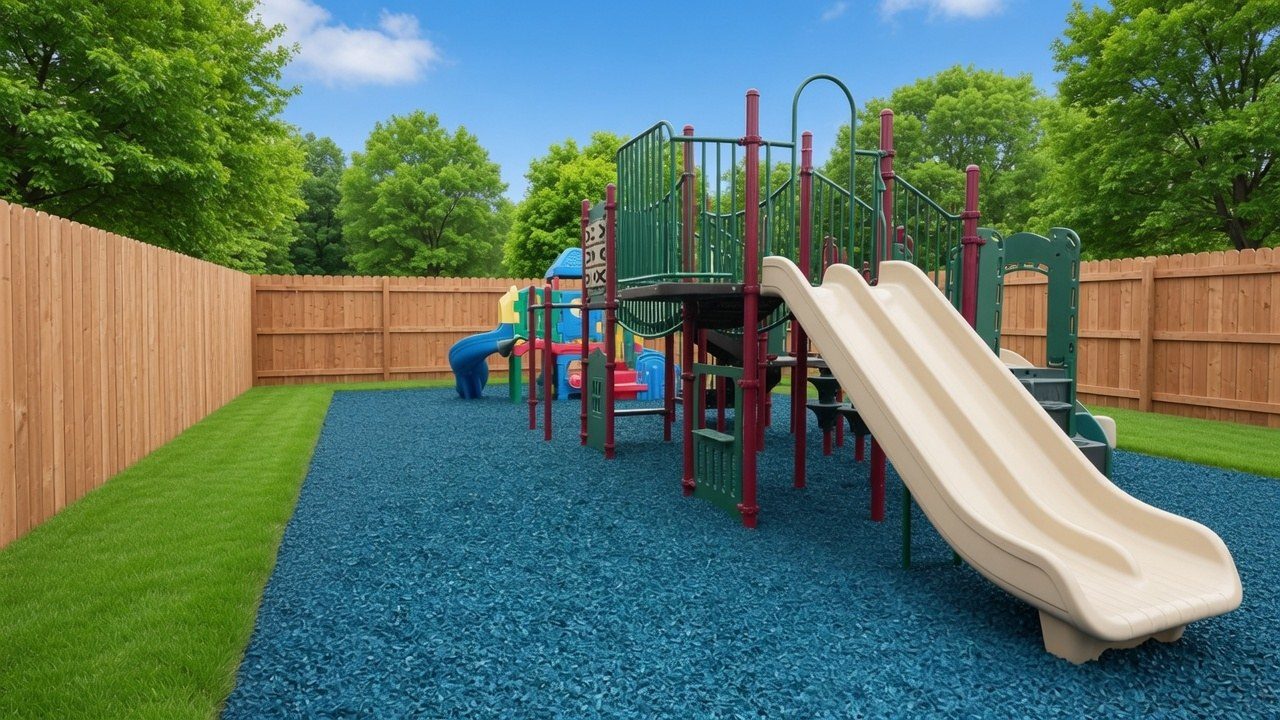
Blue Rubber Mulch
The vivid blue children pick first — a sky-and-water shade that turns a playground into somewhere kids run to.
12-Year Color GuaranteeBuy 1–5 pallets online right now with free curbside delivery. Ordering 6–9? Buy online, or request a custom quote — sometimes we can beat the listed freight. 10+ always ships by quote.
Not sure how much? Size it for me →
Enter your area any way you like — length × width, square feet, or volume. We size it to the exact pallet and set your quantity.
Several beds, or a circle or triangle? Add each one and pick its shape — we total them, so you never add lengths and multiply wrong.
1 cubic yard = 27 cubic feet.
Playground depth depends on your tallest equipment's fall height — 6″ is the common commercial starting point. We'll confirm your spec to ASTM F1292. See fall-height depths in the handbook →
Odd-shaped yard — curves, circles, a bed that wanders around the house? Measure it from your phone with AI →
 Independently IPEMA-certified to ASTM F1292, the playground fall-surface standard — verify any product at ipema.org. What this means →
How it ships
The color that makes a playground a destination.
Blue reads like water and open sky. Schools, daycares, and parks pick it for one reason: children reach for blue more than any other color. A blue surface turns an ordinary play area into the spot kids head for.
Many buyers mix blue with green, red, or unpainted for a multi-color play surface. Others match a school or team palette. Every color shares the same nugget size, so they blend and wear at the same rate.
Where blue belongs
Blue belongs in play areas — playgrounds, splash-pad surrounds, and themed or coastal spaces built for kids. Pair it with our green and red for a play set that pops, or with brown and black when you want the play zone to read calmer. Explore all six colors on the palette.
A note on heat & color
A 12-year written guarantee stands behind the color, and rubber holds its tone far longer than wood mulch, which grays and needs topping up every year or two. Blue sits in the mid-range for heat — like any surface, it warms in direct sun. For full-sun play areas, plan shade and keep to the recommended depth; our safety guide has the details.
Sources & verification: IPEMA-certified to ASTM F1292 (impact attenuation), listed in the IPEMA registry. Studied by the U.S. EPA, the European Chemicals Agency, California OEHHA and the Washington State Dept. of Health, whose findings support its safe use — full studies on our Is rubber mulch safe? page. ~80–100 tires per pallet: each pallet is recycled scrap tire, and the U.S. EPA puts a passenger tire at ~20–25 lb. Outlasts wood / no fungus: rubber is inorganic and doesn’t break down like wood, so it can’t host the artillery fungus a four-year Penn State study documented on wet wood mulch. The 12-year color guarantee is Perfect Rubber Mulch’s written warranty. Last verified July 2026.
Sold by the pallet — 75 cubic feet · 50 bags · about 2–3″ deep for landscaping beds, 6″ for playground fall protection.
The color kids choose in tests — and on the playground.
Blue does its clearest work in three settings:
Playgrounds kids love
Schools, daycares, parks, and backyard play sets reach for a bright surface kids gravitate to.
Color-matched or multi-color spaces
Match a team or school palette, or blend blue with green, red, and unpainted into one surface. It's how buyers build borders and color-blocked play zones.
Themed and coastal spaces
Water tables, splash-pad surrounds, and ocean-themed play areas lean on blue to sell the story. It reads like water the moment kids see it.
Want the whole palette? Explore all six colors →
Children reach for blue first.
Blue reads like open sky and water — bright and wide open. Children favor it more than any other color.
When researchers ask children to choose, blue wins. Psychologists Vanessa LoBue and Judy DeLoache documented it in the British Journal of Developmental Psychology — boys and girls alike favored blue over every other color. The preference appears early, holds as kids grow, and keeps blue a top pick into adulthood — which is why it belongs under a play set.
A blue playground surface puts that bright color right underfoot. Below it sits rubber that cushions falls and skips the yearly re-mulching wood demands.
Source: LoBue & DeLoache, “Pretty in Pink: The Early Development of Gender-Stereotyped Colour Preferences,” British Journal of Developmental Psychology (2011) — young children of both genders preferred blue.
How deep for a playground?
Home & backyardUpdated July 2026
| Where it’s going | Depth | Notes |
|---|---|---|
| Home & backyard playsets | 3″ | Right for most home swing sets and play structures. Home playgrounds aren’t government-regulated — this is the standard recommendation. |
| Taller home playsets | 4″ | A little extra cushion for a taller backyard structure. |
| Landscaping & garden beds | 2″ | Blocks weeds and holds soil moisture — a landscaping depth, not a safety depth. |
Home guidance follows the CPSC’s voluntary Home Playground Safety Handbook (Pub. 324). Backyard playgrounds carry no federal depth requirement.
Putting it under playground equipment? Commercial depths are set by the height a child can fall from. See the full fall-height table, or the Playground Safety Handbook.
Rubber mulch vs. the alternatives
How it comparesUpdated July 2026
| Surface | Fall protection | How long it lasts | You re-buy it? | Upkeep |
|---|---|---|---|---|
| Rubber mulch | 16 ft at 6″ | Decades — doesn't decompose | No — bought once | Rake level; top up ~10% for settling |
| Wood mulch (engineered wood fiber) | 7–10 ft at 9″ | Compresses 25%+; decomposes | Yes — to hold the 9″ depth | Rake back after use; add material to stay at 9″ |
| Poured-in-place | 12 ft when new | Hardens and cracks | Re-seal, recurring | Pro re-seal every 2–3 yrs |
Rubber fall height from our IPEMA certification (ASTM F1292-22); wood and engineered wood fiber per U.S. CPSC Pub. 325, Table 2. A pallet of rubber costs more up front than a bag of wood — but you buy it once. Your exact delivered price is in the calculator above.
Blue rubber mulch — answered.
Why do playgrounds choose blue?
Children pick blue more than any other color, so a blue surface makes a play area an easy sell. It reads like water and sky. Schools, daycares, and parks choose it to stand out, and to match school or team palettes.
Can I mix blue with other colors?
Yes — mixing is common. Blend blue with green, red, or unpainted for a multi-color play surface, or lay in patterns and borders. Every color shares one nugget size and formula, so they blend and wear at the same rate.
Will the blue fade over time?
The color is backed by a 12-year guarantee. Because rubber doesn't rot like wood, it holds its tone far longer than bark mulch, which grays and needs topping up every year or two.
Does blue rubber mulch get warm in the sun?
Any surface warms in direct sun, and blue sits in the mid-range. In full-sun play areas, plan shade and keep to the recommended depth; our safety guide has the numbers.
Is blue rubber mulch safe for playgrounds?
Yes. It's IPEMA-certified to ASTM F1292 — the impact standard referenced in the CPSC Public Playground Safety Handbook. Protection comes from the tested surface at the right depth — not the color — so install it 6 inches deep under play equipment. Full evidence: Is rubber mulch safe?
How much blue rubber mulch do I need?
One pallet covers 75 cubic feet — about a 30 × 15 ft area at 2 inches deep, or roughly 150 sq ft at a 6-inch playground depth. Quickest way to size it: use the calculator above — enter length, width, and depth for an exact pallet count. For the full tool, see the mulch calculator.